最近很多同学抱怨化学学不懂,好难应该怎么办😧,还有一个月就考试了。其实化学考的内容整体来说并没有像物理电磁那样特别考验逻辑,我认为其难的原因根本在于知识点太过琐碎(感觉可以跟隔壁统计坐一桌了)。所以,我有一个想法,我想要把内容整体给大家串一遍。既方便大家复习快速对应知识点出处,又能帮助还没有学的同学光速获取知识😂。所以,从这里,现在,开始了!!!
本文主要是对下面参考文献的翻译和整理,便于快速定位知识点和复习。有任何不妥、不清晰、不完善之处,还请查阅原文。
参考文献网址: https://apchem.org
第一单元
- 了解摩尔数$n$和相对原子质量$M$。
质谱仪
质谱仪画出的图测相对原子质量很爱考,下面是对这个图的具体描述:
- x-axis: Mass-to-charge ratio (m/z). For singly charged ions, this is effectively the mass of the isotope.
- y-axis: Relative abundance, showing how common each isotope is.
- Each peak represents an isotope of the element, and the height of the peak indicates its relative abundance.
大意就是有一个元素,通过质谱仪,由于一个元素有多种同位素,不同同位素有不同的相对原子质量,所以只要一个同位素被显现,就会产生一次波动。然后我们就可以进行计算。
The data from a mass spectrum allows calculation of the average atomic mass of an element by weighting the mass of each isotope by its relative abundance.
$$\text{Average Atomic Mass} = (\text{Mass}_1 \times \text{Abundance}_1) + (\text{Mass}_2 \times \text{Abundance}_2) + \text{...}$$
where abundances expressed as fractions, not percentages (其实就是加权平均数求期望值)。
我们通过硼(B)进行举例:
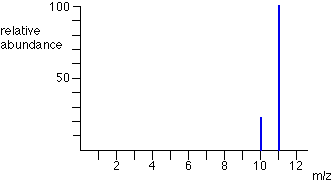
In this case, the two isotopes (with their relative abundances) are:
| Element | Relative Abundances |
|---|---|
| Boron-10 | 23 |
| Boron-11 | 100 |
The total mass of these would be $(23 \times 10) + (100 \times 11) = 1330$.
The average mass of these 123 atoms would be $1330 / 123 = 10.8$ (to 3 significant figures).
10.8 is the relative atomic mass of boron.
质谱图文献来源 https://www.chemguide.co.uk/analysis/masspec/elements.html
质谱图应用:(不太常考,可以先忽略)
- Isotope Identification: Confirms the presence and ratios of isotopes.
- Elemental Analysis: Determines the composition of unknown samples.
- Molecular Studies: Mass spectrometry can be extended to molecules, revealing their structure and composition.
- Forensics and Medicine: Used in drug testing, carbon dating, and medical diagnostics.
纯净物元素组成
Pure substance is classified as elements (单质) and compound (化合物). 因此我们可以通过此推出相对分子质量和元素在相对分子质量中的占比:
公式:
$$\text{Percent by Mass of Element} = \frac{\text{Mass of Element in 1 Mole of Compound }}{ \text{ Molar Mass of Compound}} × 100$$
依旧加权平均数。以水举例:
Water ($\ce{H2O}$)
- Molar mass of $\ce{H2O =}$ $$\ce{(2 \times 1.01 g/mol) + (16.00 g/mol) = 18.02 g/mol}$$
- Mass of $\ce{H = 2.02 g/mol}$
- Mass of $\ce{O = 16.00 g/mol}$
- Percent by mass of $\ce{ H = (2.02 / 18.02) × 100 ≈ 0.112 }$
- Percent by mass of $\ce{ O = (16.00 / 18.02) × 100 ≈ 0.888 }$
还有两个分子式,但不太重要,就不细说了:
- Empirical formula: The simplest whole-number ratio of atoms in a compound.
- Molecular formula: The actual number of atoms of each element in one molecule.
For example, glucose has a molecular formula of $\ce{C6H12O6}$ but an empirical formula of $\ce{CH2O}$.
大意就是葡萄糖可以被两种式子所写。
混合物元素组成
混合物分为均匀混合物和非均匀混合物:
- Homogeneous mixtures: These have a uniform composition throughout. They are often called solutions. Examples include salt water, air, and alloys like brass.
- Heterogeneous mixtures: These do not have a uniform composition. Different parts of the mixture can be seen and separated physically. Examples include oil and water, sand in water, or salad.
Mass/volume percent 和 mole fraction 同为加权平均数。
Molarity ($M$) is defined as the number of moles of solute per liter of solution.
这个还挺重要的,因为之后溶液的相对摩尔浓度都用这个$M$作为单位。
Molality ($m$) is the number of moles of solute per kilogram of solvent.
公式:
$$\text{m} = \frac{ \text{Moles of Solute} }{ \text{Kilograms of Solvent} }$$
Molality is independent of temperature, making it useful in studies involving colligative properties.
原子组成
- 质子(proton)positively charged 带正电
- 中子(neutron) neutral 不带电
- 电子(electron) negatively charged 带负电
- 原子核(nucleus)= 质子 + 中子
原子排布
原子核外排布着一圈又一圈的电子轨道,不同的轨道蕴含着不同的能量和不同互谅的电子,电子轨道的volume从里向外逐渐增大。从里向外依次是s、p、d、f。
The main types of orbitals are s, p, d, and f:
- s orbitals are spherical and can hold up to 2 electrons.
- p orbitals are dumbbell-shaped and can hold up to 6 electrons.
- d orbitals can hold up to 10 electrons.
- f orbitals can hold up to 14 electrons.
电子在轨道上的排布规律必须遵循3个定律:
- Aufbau Principle: Electrons fill the lowest-energy orbitals first before moving to higher-energy orbitals. 先填满里面的,再填外面的
- Pauli Exclusion Principle: Each orbital can hold a maximum of two electrons, and these must have opposite spins. 每个小轨道上的电子排布⬆️⬇️
- Hund’s Rule: When filling orbitals of the same energy, electrons occupy them singly with parallel spins before pairing up.
These rules ensure that electrons are distributed in the most stable arrangement possible.
其实就相当于s有一个小房间,p有3个,d有5个,f有7个,每个小房间最多只能有两个电子。
书写电子构型 Writing Electron Configurations
Electron configurations are written using numbers and letters that indicate the energy level and type of orbital, along with superscripts to show the number of electrons.
在第几族就表示s或者p或者d同族的前面的系数(比如2s前面的2),轨道上面的数字标表示在这个小轨道上的有几个电子(比如3d⁶表示在3d这个小轨道上有6个电子排布)
- Hydrogen (Z = 1): 1s¹
- Oxygen (Z = 8): 1s² 2s² 2p⁴
- Iron (Z = 26): [Ar] 4s² 3d⁶(这里Ar开头意味着前面的电子排布轨道和Ar相同,后面跟着的是在此基础上叠加电子所形成的产物)
来看看此玩意在元素周期表中的运用
- Elements in the same group have similar outer electron configurations, leading to similar chemical properties. 同族元素有相似外电子排布例如氢和锂外部都是s¹,所有化学性质相似
- Moving across a period adds electrons to the same energy level, gradually filling orbitals. 同周期元素从左向右依次在亚轨道和小房间中累加电子
- Moving down a group adds new shells, increasing the size of atoms and changing their reactivity. 从一族移到下一族增加一个原子层,增加原子半径
Photoelectron Spectroscopy 光电子光谱
- Ionization Process: In PES, a photon (usually from ultraviolet or X-ray radiation) hits an atom or molecule, causing an electron to be ejected.
- Kinetic Energy Measurement: The energy of the ejected electron is measured. The binding energy of the electron is calculated using the equation:
Binding Energy = Photon Energy − Kinetic Energy of Electron
- Information Obtained: The binding energy reflects the energy required to remove an electron from a particular orbital, providing insight into the electronic configuration of the atom or molecule.
这玩意也挺容易考的
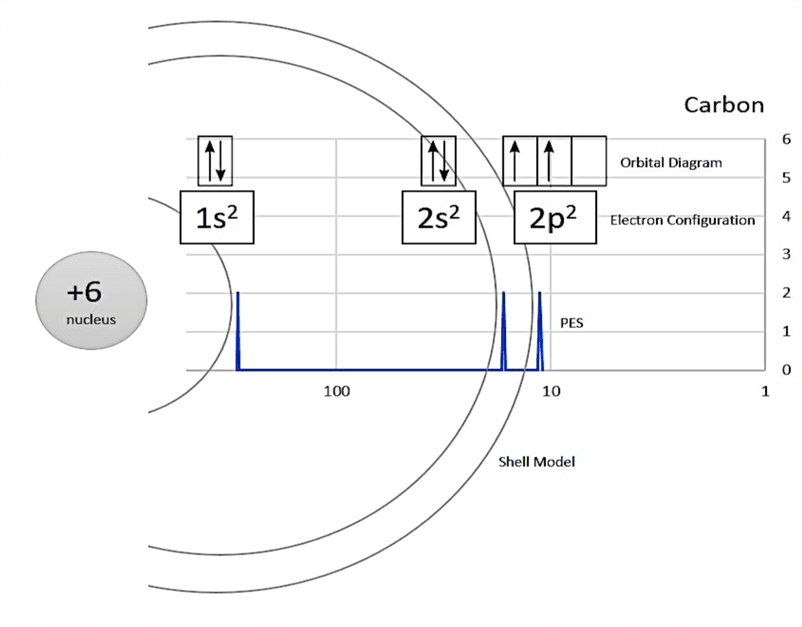
主要应用在于根据亚电子轨道来判断此是何物。
这个图,从左往右依次是1s, 2s, 2p...
然后注意观察纵坐标吧,作者找的这个图峰高都是一样的,假如不一样,应当通过矮的和高的对比来看出亚轨道上面的数字标究竟是多少。
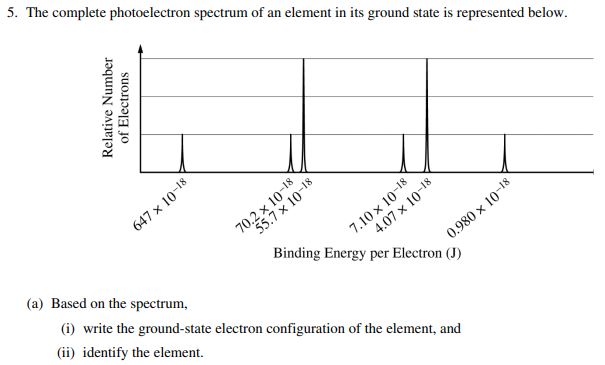
这个更复杂,但其实就是考试原题
答案:1s² 2s² 2p⁶ 3s² 3p⁶ 4s²
这个直到最后一个是4s²,所以这个物质是$\ce{Ca}$。
题目和图片来源 https://fiveable.me/ap-chem/unit-1/photoelectron-spectroscopy/study-guide/Xx7nwanr96Uzt1zSvwRA
元素周期表的一些基本规律
Atomic Radius 原子半径
- Trend down a group: Atomic radius increases because new electron shells are added, increasing the distance between the nucleus and the outermost electrons.
- Trend across a period: Atomic radius decreases from left to right. Although more protons are added to the nucleus, pulling electrons inward, no new shells are added, so the effective nuclear charge increases and the atom becomes smaller.
- 同族从上到下半径从小到大
- 同周期从左向右半径从大到小
Ionization Energy 电离能
Ionization energy is the energy required to remove an electron from an atom.
- Trend down a group: Ionization energy decreases because the outer electrons are farther from the nucleus and experience less attraction.
- Trend across a period: Ionization energy increases from left to right due to stronger nuclear attraction as effective nuclear charge increases.
- 同族从上到下电离能减小
- 同周期从左往右电离能增大
Electronegativity 电负性
Electronegativity is the ability of an atom to attract shared electrons in a bond.
- Trend down a group: Electronegativity decreases as atomic size increases, reducing the pull on bonding electrons.
- Trend across a period: Electronegativity increases from left to right as atoms become smaller and nuclear charge increases.
- 族从上到下电负性减小
- 周期从左往右电负性减小
Electron Affinity 电子亲合能
Electron affinity measures the energy change when an atom gains an electron.
- Trend down a group: Electron affinity generally becomes less negative (less favorable) due to increased distance between the nucleus and the added electron.
- Trend across a period: Electron affinity generally becomes more negative (more favorable), especially for halogens, as atoms more strongly attract extra electrons to complete their valence shell.
电子亲合能…
- …同族从上到下更弱
- …同周期从左往右更强
Metallic Character 金属性
Metallic character refers to the tendency of an element to lose electrons and form cations.
- Trend down a group: Metallic character increases because ionization energy decreases.
- Trend across a period: Metallic character decreases from left to right as elements become less likely to lose electrons and more likely to gain them.
金属性…
- …从上到下增加
- …从左往右减少
一个元素的价电子(Valence Electrons)实际上就是最外层电子数。
举例:
- Group 1 (alkali metals) have 1 valence electron and readily form +1 cations.
- Group 17 (halogens) have 7 valence electrons and tend to gain 1 electron to form -1 anions.
为了形成化合价,必须达到8电子稳定结构。有的元素得电子很容易,有的元素失电子很容易,具体情况具体分析。原子得失电子后就变成了正负离子,正负离子相结合就变成了ionic compounds
离子的形成
- Metal loses electrons → forms a cation
- Nonmetal gains electrons → forms an anion
- Electrostatic attraction between cation and anion forms an ionic bond
离子化合物性质 Properties of Ionic Compounds
- High melting and boiling points due to strong ionic bonds
- Solid at room temperature with crystalline structures
- Conduct electricity when molten or dissolved in water, because ions are free to move
第二单元
化学中的各种键
- 离子键(ionic bond):阴阳离子之间存在的相互吸引的力
- 共价键(covalent bond):各种原子为了达到稳定结构开始共用电子,所以可能有单键,双键,三键,一个键共享出去一个e$^-$
- 金属键(metallic bond):大致意思是由带正电的金属离子构成,离域电子在此间自由运动(此键并不常考)
共价键中的极性(polar) vs 非极性(nonpolar)
- Nonpolar: Electrons are shared equally; occurs between identical or similar electronegativity atoms.
发生在电负性近似,差别不是很大的两个原子之间,电子平均共享。因为两个原子的核电荷数(元素周期表上的n号元素)相近,所以电子被两个差不多的原子平分了。极性反之亦然。
- Polar: Electrons are shared unequally; one atom attracts electrons more strongly.
分子间作用力和分子势能
分子间作用力
- 共价键:当形成共价键的时候,键能很强且具有方向性
- 离子键:当一个电子从一个原子转移至另一个原子,形成的阴阳离子将会产生静电引力
- 金属键:存在于金属之中,电子在金属阳离子构成的晶格中发生离域,从而赋予金属导电性与延展性。
Potential Energy and Bonding
- Potential energy: 由于各原子之间的相对位置而在一个系统中所产生的储存的能量,势能越小分子越稳定。键形成的过程之中,势能减小。
破键需要大量能量,因此需要能量(吸热),同时势能增加。
$$\text{化学反应的实质是旧键的断裂和新键的生成}$$
- 当断裂的能量大于新生成的能量,此反应为吸热反应($\ce{\Delta H > 0}$)
- 当断裂的能量小于新生成的能量,此反应为放热反应($\ce{\Delta H < 0}$)
(此内容后续热力学会重点讲)
强键对应弱势能和更加稳定的分子结构。
Structure of Ionic Solids
Ionic solids are composed of positive and negative ions held together by strong electrostatic forces.
- Crystal Lattice Structure: 晶体晶格是离子的三维排布结构,其中每个阳离子均被阴离子包围,反之亦然。
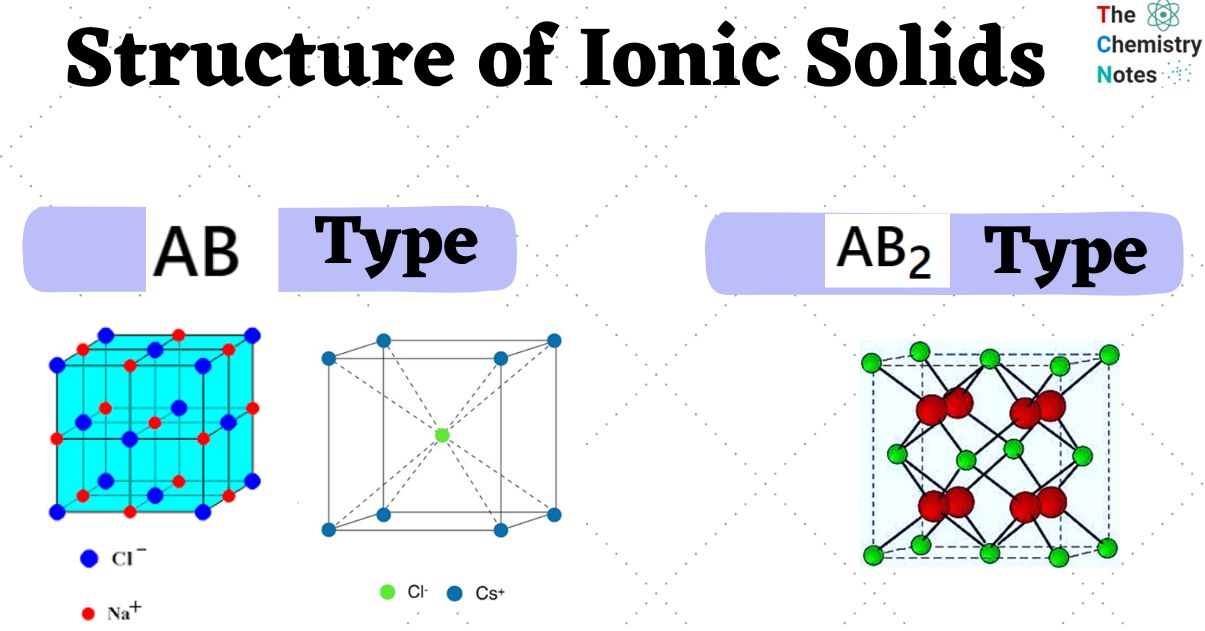
Coordination number:
- The number of oppositely charged ions immediately surrounding an ion in a lattice.
- Example: In $\ce{NaCl}$, each $\ce{Na+}$ is surrounded by 6 $\ce{Cl-}$ ions (coordination number = 6).
指中心离子周围直接成键的原子、离子或分子(配体)的总数。
中心原子 / 离子:半径越大/电荷越高,配位数越高
Types of Ionic Lattices:
- Simple Cubic (SC): Rare in ionic solids, each ion contacts six neighbors.
- Face-Centered Cubic (FCC): Common in $\ce{NaCl}$ structure, high packing efficiency.
- Body-Centered Cubic (BCC): Less common, moderate packing efficiency.
Ionic Solids 的性质:
- 高熔点/沸点
- 易碎的(brittle)
- 导电性
金属和合金的结构:
金属结构:
- 金属原子以规则的晶格结构排列,以最大限度提升稳定性与堆积效率。
- 金属原子中存在大量可以自由移动的电子,这赋予了金属导电性。
常见的金属晶格 Common Metallic Lattices (通常不咋考,了解就行)
- Face-Centered Cubic (FCC): High packing efficiency, common in metals like copper, aluminum, and gold.
- Body-Centered Cubic (BCC): Moderate packing efficiency, found in metals like iron and chromium.
- Hexagonal Close-Packed (HCP): Found in metals like magnesium and zinc, offering dense packing.
- 合金结构:金属+金属 / 金属+非金属
合金可以分为两类:
- Substitutional Alloy: Some metal atoms are replaced by other atoms of similar size (e.g., brass: $\ce{Cu + Zn}$).
- Interstitial Alloy: Smaller atoms fit into the spaces (interstices) between metal atoms (e.g., steel: $\ce{Fe + C}$).
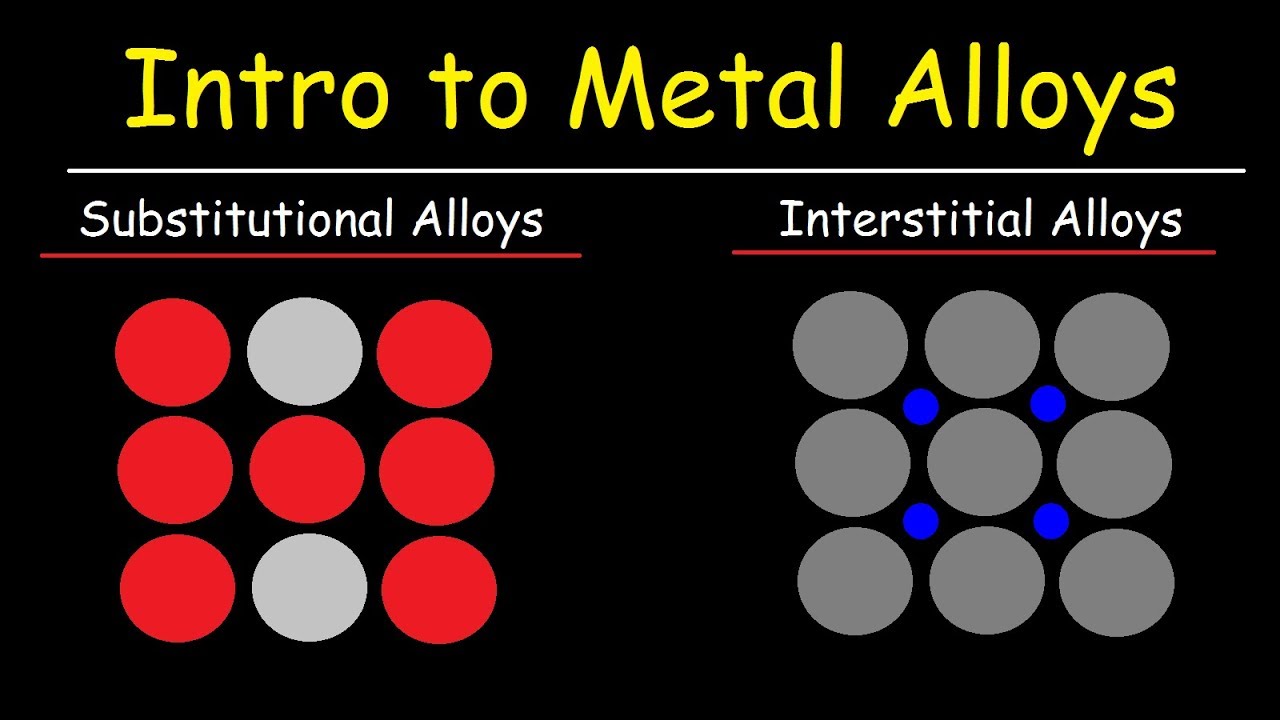
两种原子,半径相似就是substitutional alloy,相差太大则反之。
- 合金的性质:在金属的基础上,拥有良好的导热性,延展性和可塑性,还有一般金属所没有的坚硬。
路易斯点图 Lewis diagram
[!IMPORTANT]
这一部分常考,注意重点。
路易斯电图详细描述了分子中原子间电子是怎样排布的。
路易斯点图怎么画?
Basic Rules for Drawing Lewis Diagrams
- Count total valence electrons: Sum the valence electrons of all atoms in the molecule or ion.
- Determine the central atom: Usually the least electronegative atom (except hydrogen).
- Draw single bonds: Connect the central atom to surrounding atoms with single bonds.
- Distribute remaining electrons: Complete octets (or duets for hydrogen) for outer atoms first.
- Check for multiple bonds: If the central atom does not have an octet, form double or triple bonds as needed.
这里讲一个普适方法(和上面英文叙述的思路大差不差),适用于各种分子和离子团。这里我先用$\ce{SO3}$进行举例。
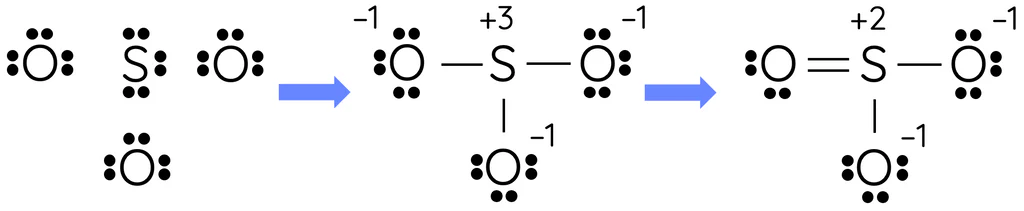
- 我们要将所有原子的核外电子数全加起来算出一个电子量总数。$$6 \text{ (S的核外电子数)} + 3 \times 6 \text{ (O的核外电子数)} = 24$$
- 我们决定一个中心原子,其他原子围绕着它进行排布。一般选择电负性更小的那一个。
先将每两个原子之间填充单键,然后尽量让每个原子都达到8电子稳定结构(H只需要2)
- 每个S和O之间都有两个,乘3变成6。
- 现在S周围有6个了,我们接着可以把每个O先配两个孤电子对,先尽量多排一点电子,就是排到一个临近与8的值,一般是6。
- 一个孤电子对是2,两个是4,乘3等于12。
- 现在我们排列18个了,还差6个。
这6个咋办呢? - 还是那个原子,要把每个原子都配稳定。我们可以给两个O各一对孤电子对,这样我们的两个O配好了,就剩两个电子了。
- 我们还差一个S一个O稳定,那没办法,只能配在最后一个O和S之间形成双键了。只有这样配,四个原子都达到了稳定结构。所以$\ce{SO3}$就具有四个键。
(上面是作者的逻辑过程,可能有点冗长,但肯定你们都能看懂😋)
这大概就是路易斯点图的画法。
Resonance and Formal Charge
Resonance occurs when a molecule can be represented by two or more valid Lewis structures (resonance structures) that differ only in the placement of electrons, not atoms.
Purpose: Resonance structures depict delocalized electrons, which are spread over multiple atoms, stabilizing the molecule.
我对于共振式的理解呀,就是比如说啊,当你用路易斯点图画出来一个分子或者离子团的时候,你会发现,分子中的有些原子之间,有时是单键,有时是双键,甚至三键。但是根据科学家的推断来说,按理说每两个原子之间键的数量和强度都是一样的。但画图时,为了方便,不能一个画$\frac{4}{3}$个键。所以在面对共振式,比如上面的三氧化硫,它的共振式就有三个,因为你的双键由于没有限制,可以画到任何两个原子之间(还要根据具体情况而定)。但它的键长每个确实都是一样的,都是$1.33$左右。
Formal Charge
- Definition: Formal charge is a bookkeeping tool used to determine the electron distribution within a molecule.
Formula:
$$\text{Formal Charge} = (\text{Valence electrons in free atom}) − (\text{Nonbonding electrons}) − \frac{1}{2} (\ce{Bonding electrons})$$
这个会算就行,考试不经常考。
VSEPR and Bond Hybridization
- VSEPR理论:核心是价层电子对互斥,用于解释分子几何构型,原子通过排布使电子对斥力最小化。
- 杂化轨道理论:说明原子轨道重新组合形成新的杂化轨道,阐释分子成键方式。
二者共同用于理解分子空间结构与成键规律。
VEEPR理论其实很简单,就是你要查一个分子的有几个键,几个孤电子对。然后来决定这个分子的空间构型。
[!NOTE]
在此理论中,孤电子对和成键数都会影响到分子的形状,影响的效果不同。一个分子有不同的键数和孤电子对,它的形状就不同,有直线,等边三角形,三棱锥......并且,在形成空间构型后,有时候顶部分子(中部分子)的两个键之间的夹角也爱考。常考的就是直线,平面三角形,正四面体(甲烷)和三棱锥(氨气)的顶部夹角为多少,分别是180度,120度,109.5和107度。
- Linear: 2 bonding pairs, 0 lone pairs (e.g., $\ce{CO2}$)
- Trigonal Planar: 3 bonding pairs, 0 lone pairs (e.g., $\ce{BF3}$)
- Tetrahedral: 4 bonding pairs, 0 lone pairs (e.g., $\ce{CH4}$)
- Trigonal Pyramidal: 3 bonding pairs, 1 lone pair (e.g., $\ce{NH3}$)
- Bent: 2 bonding pairs, 1 or 2 lone pairs (e.g., $\ce{H2O}$)
Bond Hybridization
- Definition: Hybridization is the mixing of atomic orbitals to form new hybrid orbitals suitable for bonding.
Types:
- sp: Linear geometry
- sp$^2$: Trigonal planar
- sp$^3$: Tetrahedral
这个杂化理论也非常简单好吧。就是考试的时候就记住,p上面的数字标表示,分子中,每两个原子之间的间数-1,比如$\ce{CO2}$有两个间数,所以它的杂化方式就是sp,以此类推。
第三单元
Intermolecular Forces
分子间作用力(intermolecular force)作为一种分子之间的吸引力和排斥力。相比于分子内部键之间的力(intramolecular force)虽然很小,但依然会在决定某一物质的物理性质时起关键作用(沸点,熔点,溶解度,气压)。
Types of intermolecular forces
London Dispersion Forces (Van der Waals)
这个力相对来说比较普遍,所有分子之间都会有。
由于电子在原子之间不停地运动,因此在某一刻电子会存在分布不均的状况(电子云不对称)。因此会瞬间产生吸引/排斥现象,我们叫做偶极(dipole)。因此诱导其他分子产生偶极。我们把它在一瞬间互相吸引的力叫做伦敦色散力,其会伴随着分子量和电子的变大而增强。
- Present in all molecules, especially non-polar.
- Caused by temporary dipoles due to electron motion.
- Strength increases with molecular size and polarizability.
Dipole-Dipole Interactions
分子必须是极性分子才能产生。
两个分子电负性差异都很大,其中某个分子中电负性小的原子会和另一个分子中电负性大的原子相互吸引,所以产生此力。
- Occur in polar molecules with permanent dipoles.
- Positive end of one molecule attracts the negative end of another.
Hydrogen Bonding
必须满足一个分子里有 $\ce{N-H}$、$\ce{O-H}$、$\ce{F-H}$ 键并且另一个分子里有 N、O、F 上的孤对电子。
H会被电负性强大的N,O,F 拉扯变形。成为只剩一个质子的氢离子。这个氢离子会和N,O,F的孤电子对相互吸引,产生强大的力。
- Special case of dipole-dipole.
- Occurs when hydrogen is covalently bonded to highly electronegative atoms (N, O, F) and attracted to lone pairs on another molecule.
- Responsible for water’s high boiling point and unique properties.
Ion-Dipole Interactions
不常见。
- Occur between ions and polar molecules.
- Important in solutions where ionic compounds dissolve in polar solvents like water.
[!NOTE]
四种力大小排序
离子键 > 氢键 > 偶极 - 偶极 > 伦敦色散力
Properties of Solids
固体的一些性质:固体由于强分子间作用力或者离子间作用力连接在一起。
- Definite Shape and Volume: Particles vibrate but do not move freely.
- High Density: Particles are closely packed.
- Incompressibility: Little empty space between particles.
- Melting Point: Stronger forces require higher energy to overcome.
- Electrical Conductivity: Depends on type of solid (ionic solids conduct when molten, metals conduct in solid state).
Types of Solids
Crystalline Solids(晶体)
- Particles arranged in a regular, repeating pattern.
- Examples: NaCl, diamond, quartz.
- Have sharp melting points and well-defined structures.
Amorphous Solids(非晶体)
- Particles lack long-range order.
- Examples: Glass, rubber.
- No sharp melting points; soften over a range of temperatures.
Factors Affecting Solid Properties
- Type of Bonding: Ionic, covalent, metallic, or molecular.
- Intermolecular Forces: Stronger forces result in higher melting points.
- Crystal Structure: Determines hardness, cleavage, and other physical properties.
Solids, Liquids, and Gases
Solid
- 固体固形
- 密度高,分子间作用力最强,分子紧密排布
Liquid
- 固体不固形
- 中等密度,分子间作用力适中
Gas
- 不固体不固形
- 密度最小,分子间作用力最弱
Phase Transitions
- Melting(溶化): Solid → Liquid
- Freezing(凝固): Liquid → Solid
- Vaporization/Boiling(蒸发/沸腾(其实就是(发生程度缓和/剧烈之分)): Liquid → Gas
- Condensation(液化): Gas → Liquid
- Sublimation(升华): Solid → Gas
- Deposition(凝华): Gas → Solid
Ideal Gas Law
Assumptions of the Ideal Gas Law
我们首先会对理想气体提出几个假设。
- 气体分子的体积忽略不计;
- 并没有分子间作用力的产生;
- 气体分子之间进行弹性碰撞(动量守恒);
- 必须在高温低压下进行。
理想气体方程
$$PV = nRT$$
Key Concepts
- Pressure ($P$): The force exerted by gas molecules per unit area on the container walls.
- Volume ($V$): The space occupied by the gas.
- Temperature ($T$): Measures the average kinetic energy of gas molecules.
- Moles ($n$): Amount of substance.
- Gas Constant ($R$): $\ce{0.0821 L·atm/(mol·K)}$ or $\ce{8.314 J/(mol·K)}$, depending on units used.
Limitation
真实气体可能会在低温高压下并且存在分子间作用力。
Kinetic Molecular Theory
分子动理论(KMT)基于粒子的运动来解释气体的行为。该理论有助于预测气体在温度、压强和体积发生变化时的响应。
Postulates of Kinetic Molecular Theory
- Gas particles are in constant, random motion.
气体分子一直在无规则运动。 - Gas particles are very small compared to the distance between them; most of the gas volume is empty space.
与气体分子之间距离相比,气体分子特别小,这就意味着容器内大部分空间都是空的。 - Collisions between gas particles and container walls are elastic, meaning no kinetic energy is lost.
所以碰撞都是弹性碰撞,因此没有动量和动能损失。 - No intermolecular forces exist between gas particles; they do not attract or repel each other.
没有分子间作用力。 - Average kinetic energy of gas particles is proportional to temperature in Kelvin.
温度越高,分子平均动能越大。
其实我感觉分子动理论实质上是在理想气体的条件下分子运动的规律,因此其限制条件和理想气体类似。
Deviation from Ideal Gas Law
实际情况下,理想气体模型几乎不成立,因为气体分子免不了相互产生吸引力,并且温度也并不是一定可以在高温低压的条件系进行。在现实中,气体分子的体积是有限的。气体分子会占据很多空间。在高压条件下,分子本身体积相较于总体积会变得十分显著,从而导致偏差产生。
Van der Waals Equation
此方程是为了修正理想气体的限制,而进行的调整。
$$(P + a (\frac{n}{V})²) \cdot (V − nb) = nRT $$
Where:
- $a$ = measure of intermolecular attraction
- $b$ = volume occupied by gas molecules
- $n$ = number of moles
- $V$ = volume
- $R$ = gas constant
- $T$ = temperature
太难了,作者认为不会考,了解即可。
Solutions and Mixtures
Types of Mixtures
Homogeneous Mixtures
- Uniform composition throughout
- Examples: Salt water, air
Heterogeneous Mixtures
- Non-uniform composition; distinct phases
- Examples: Sand in water, oil and water
Components of a Solution
- Solute: Substance being dissolved
- Solvent: Substance that dissolves the solute
- Concentration: Amount of solute in a given quantity of solvent or solution
Properties of Solutions
- 离子大小分为离子级和分子级
- 静置无沉淀
- 容质不能被过滤
- 展现colligative properties (e.g., boiling point elevation, freezing point depression)
Representations of Solutions
接下来我们要了解的是关于一些溶液浓度的东西。
Concentration Units
Molarity ($M$)
常用单位。
- Moles of solute per liter of solution.
$$M = \frac{n \text{ (solute)}}{V \text{ (solution)}}$$
Molality ($m$)
- Moles of solute per kilogram of solvent.
$$m = \frac{n \text{ (solute)} }{ \text{mass} \text{ (solvent in kg)}}$$
Percent Composition
- Mass Percent: $$\frac{\text{mass of solute}}{\text{mass of solution}} \times 100\%$$
- Volume Percent: $$\frac{\text{volume of solute}}{\text{volume of solution}} \times 100\%$$
- Mass/Volume Percent: $$\frac{\text{mass of solute}}{\text{volume of solution}} \times 100\%$$
Mole Fraction ($\chi$)
- Ratio of moles of one component to total moles in solution.
$$\chi = \frac{n \text{ (component)}}{n \text{ (total)}}$$
以上是所有表示浓度的东西和单位。
Dilution
- Definition: 添加更多溶剂减少浓度
- Equation:
$$C_1 V_1 = C_2 V_2$$
- $C_1$ = initial concentration
- $V_1$ = initial volume
- $C_2$ = final concentration
- $V_2$ = final volume
Separation of Solutions and Mixtures Chromatography
色谱法(chromatography)是依据混合物各组分与固定相、流动相相互作用的差异,实现组分分离的技术。我们可以用此方法来判断混合物的组成成分。
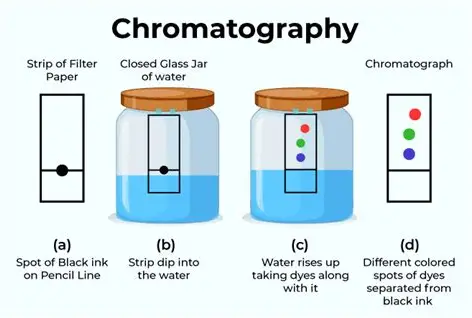
Types of Chromatography
其实原理大差不差。除了纸层析,其他都不太常考。
Paper Chromatography
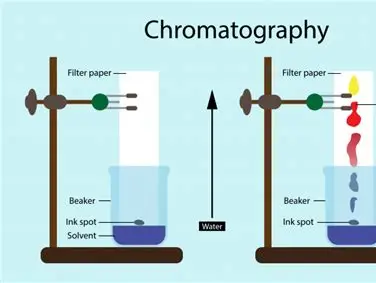
- Stationary phase: Paper
- Mobile phase: Solvent
- Separation occurs due to different solubilities and capillary action.
[!NOTE]
关于固定相(origin)和流动相(混合物中的溶质)关系
在纸层析里:
- 固定相:滤纸纤维 + 水 → 极性很强
- 流动相:展开剂(有机溶剂)→ 一般极性较弱/非极性
规律:
- 极性大的物质:更爱留在固定相,跑得慢、近
- 非极性大的物质:更爱跟着流动相走,跑得快、远
所以: 移动越远 = 非极性越强 / 极性越弱
Thin-Layer Chromatography (TLC)
- Stationary phase: Thin layer of adsorbent (silica gel or alumina) on a plate
- Mobile phase: Solvent
- Used for quick analysis and monitoring reactions.
Column Chromatography
- Stationary phase: Packed column of adsorbent
- Mobile phase: Solvent flows through column
- Separates larger quantities of substances.
Gas Chromatography (GC)
- Mobile phase: Inert gas
- Stationary phase: Liquid or polymer coating inside a column
- Used for volatile compounds.
High-Performance Liquid Chromatography (HPLC)
- Advanced liquid chromatography with high pressure
- Offers high resolution and precise separation.
Solubility
这里主要讲一些关于影响溶液溶解度的定义,因素,还有饱和溶液。
Factors Affecting Solubility
Nature of Solute and Solvent
- 相似相溶:极性溶质易溶极性溶剂,非极性反之亦然
Temperature
- 大多数物质的溶解度温度上升,溶解度变大
Pressure (mainly affects gases)
- 高压增加气体在液体中的溶解度(碳酸饮料)
Henry’s Law: $$S = kP$$
Common Ion Effect
- 已经存在的离子会降低盐的溶解度
Saturation
- Unsaturated: 还可以容纳更多的溶质,没达到限制
- Saturated: 已经达到了可溶解限制,动态平衡开始进行
- Supersaturated: 超过上限,会自发析出晶体或者沉淀
Spectroscopy and the Electromagnetic Spectrum
光谱学研究电磁辐射与物质的相互作用,是化学中用于识别物质、探究原子及分子结构的基础工具。在前面,我们就已经运用了光谱图来计算平均相对原子质量。
Electromagnetic Spectrum
- Radio waves: (波长越来越短,频率越来越高)
Microwaves → Infrared → Visible → Ultraviolet → X-rays → Gamma rays - Wavelength ($\lambda$): Distance between successive peaks of a wave
- Frequency ($\nu$): Number of wave cycles per second
- Energy ($E$): $E = h\nu$, where $h$ is Planck’s constant
Types of Spectroscopy
认识即可,不考。
UV-Vis Spectroscopy
- Measures absorption of ultraviolet or visible light
- Provides information about electronic transitions
IR Spectroscopy
- Measures absorption of infrared light
- Provides information about molecular vibrations and functional groups
NMR Spectroscopy
- Uses radio waves in a magnetic field to probe atomic nuclei
- Determines structure of organic compounds
Mass Spectrometry (MS)
- Measures mass-to-charge ratio of ions
- Identifies molecular weight and fragmentation patterns
Photoelectric Effect
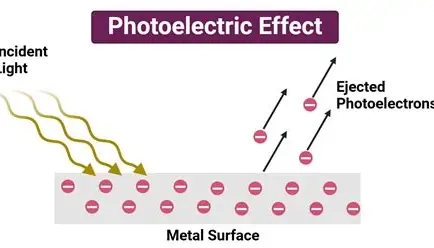
光电效应大致原理:
- 我们首先认为光具有波粒二象性(既有粒子的性质也有波的性质)。在一个光子碰撞金属板的时候,由于光子没有质量,所以在碰撞的时候,能量进行传递。
- 金属板上的电子接收到向金属板的能量之后就会进行一种能量的反射现象。
- 原子带着能量从金属板出去了。
Key Principles
- Photon Energy: Each photon has energy $E = h\nu$, where $h$ is Planck’s constant and $\nu$ is the frequency of light.
- Work Function ($\phi$): Minimum energy required to remove an electron from a metal.
- Kinetic Energy of Ejected Electrons:
$$\text{KE} = h \nu − \phi$$
对于AP化学来说,考试时他会给一个坐标图,会应用公式即可。
Beer-Lambert Law
和观光电效应要求一致,会应用即可。
朗伯-比尔定律描述了溶液对光的吸光度与溶液性质之间的关系,它是光谱学和分析化学中用于测定物质浓度的基本原理。
Statement of the Law
The Beer-Lambert Law can be expressed as:
$$A = \epsilon \times l \times c$$
Where:
- $A$ = absorbance (unitless)
- $\epsilon$ = molar absorptivity or extinction coefficient ($\ce{L \cdot mol^{-1} \cdot cm^{-1}}$)
- $l$ = path length of the sample ($\ce{cm}$)
- $c$ = concentration of the absorbing species ($\ce{mol \cdot L^{-1}}$)
Key Concepts
- Absorbance ($A$): A measure of how much light is absorbed by a solution.
- Molar Absorptivity ($\epsilon$): A constant that indicates how strongly a species absorbs light at a given wavelength.
- Path Length ($l$): The distance light travels through the solution.
- Concentration ($c$): The amount of solute per unit volume of solution.
哇怎么评论区全是托……??
同学之力🤓👆
哇塞厉害👍
Alexander太厉害了,等我学ap化学的时候(大概是永远不会)我就来全职研究这个文章!
(((o(゚▽゚)o)))